

Most "budget travel tips" lists repeat the same handful of generic advice without explaining why it works or how much it actually saves. The tips below are ranked roughly by impact — the ones that move the needle on a travel budget the most come first, followed by smaller adjustments that add up over the course of a trip.
▤ Contents⌃
- 11. Fly Mid-Week Instead of Weekends
- 22. Use Flexible Date Search Tools Before Locking In Dates
- 33. Travel During Shoulder Season
- 44. Choose Destinations Where the Cost of Living Works in Your Favor
- 55. Book Accommodation Based on Reviews, Not Star Ratings
- 66. Use Points and Miles Where Possible
- 77. Compare Budget Airlines Carefully, Not Just by Ticket Price
- 88. Eat Where Locals Eat
- 99. Use Public Transportation Instead of Taxis
- 1010. Download Free Travel Apps Before Departure
- 1111. Pack Light to Avoid Baggage Fees
- 1212. Set Up Price Alerts Instead of Checking Manually
- 1313. Avoid Currency Exchange Counters at Airports
- 1414. Book Activities Directly Instead of Through Hotel Concierges
- 1515. Travel Slower Rather Than Covering More Ground
- 16Quick Reference: Where Each Tip Saves the Most
- 17Frequently Asked Questions
- 18Putting These Together
1. Fly Mid-Week Instead of Weekends
Flights departing Tuesday or Wednesday are consistently cheaper than Friday, Saturday, or Sunday departures, since weekend travel demand is higher across almost every route. This single scheduling change can cut flight costs noticeably without requiring any extra research or booking tools. A deeper breakdown of flight pricing patterns is available in how to find cheap flights without using a travel agent.
2. Use Flexible Date Search Tools Before Locking In Dates
Most flight search engines offer a flexible date or "cheapest month" view. Comparing prices across a range of dates instead of a single fixed date can reveal savings of $50-150 per ticket on the same route, particularly for international flights.
3. Travel During Shoulder Season
The weeks just before or after a destination's peak season typically offer 20-40% lower prices on both flights and accommodation, with only a small tradeoff in weather or crowd levels. This is one of the highest-impact budget decisions a traveler can make, and it's covered in more detail in off-season travel: how to save big by timing it right.
4. Choose Destinations Where the Cost of Living Works in Your Favor
Currency strength and local cost of living affect a travel budget more than almost any single money-saving tactic. A trip to a destination with a lower cost of living can cost half as much as an equivalent trip somewhere more expensive, for a comparable experience. A ranked list of currently affordable destinations is in cheapest countries to visit in 2026.
5. Book Accommodation Based on Reviews, Not Star Ratings
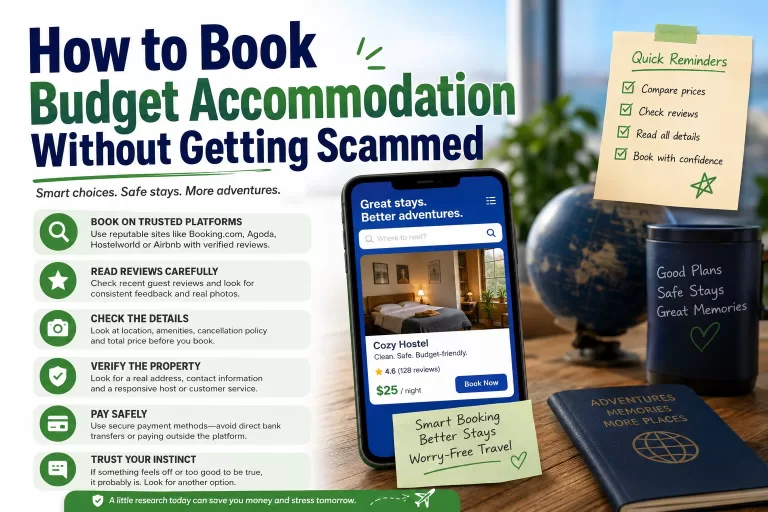
Star ratings are often self-reported or based on outdated criteria. Recent guest reviews are a far more reliable indicator of actual value, and prioritizing this over rating alone consistently leads to better bookings at lower prices. A full guide to avoiding bad bookings is in how to book budget accommodation without getting scammed.
6. Use Points and Miles Where Possible
Credit card rewards programs and airline loyalty points can offset a significant portion of flight costs, particularly for travelers who put regular spending on a rewards card and redeem strategically. This requires some upfront setup but pays off substantially on longer or more frequent trips. The mechanics of this are explained in how to use points and miles to fly for free.
7. Compare Budget Airlines Carefully, Not Just by Ticket Price
Budget airlines often advertise low base fares but add fees for baggage, seat selection, and even printing a boarding pass. Comparing the total cost — not just the headline price — frequently changes which airline is actually cheaper. A full comparison of how to book budget airlines correctly is in best budget airlines and how to book them cheaply.
8. Eat Where Locals Eat
Restaurants aimed at tourists are consistently priced higher than local eateries serving the same type of food. Street food stalls, markets, and small family-run restaurants tend to be both cheaper and more representative of local cuisine. Specific strategies for cutting food costs without sacrificing quality are in how to save money on food while traveling abroad.
9. Use Public Transportation Instead of Taxis
Local buses, metros, and shared transport options are almost always dramatically cheaper than taxis or ride-hailing apps, and the savings compound quickly over the course of a trip. A full cost comparison, including when a rental car actually makes more sense, is in public transport vs. renting a car: a budget comparison.
10. Download Free Travel Apps Before Departure
A handful of free apps — for offline maps, currency conversion, translation, and finding local deals — can meaningfully reduce both stress and unexpected costs during a trip. A list of the most useful ones is in 10 free travel apps that save you hundreds of dollars.
11. Pack Light to Avoid Baggage Fees
Checked baggage fees on budget airlines can add $30-80 per flight each way, and overpacking often results in paying for space that isn't actually needed. Traveling with a well-planned carry-on avoids this cost entirely on most short and medium trips.
12. Set Up Price Alerts Instead of Checking Manually
Manually checking flight and accommodation prices repeatedly rarely beats simply setting up automated price alerts and waiting for a notification. This removes the temptation to book early out of anxiety about prices rising, and it surfaces genuine drops without extra effort.
13. Avoid Currency Exchange Counters at Airports
Airport currency exchange counters typically offer the worst rates of almost any exchange option available. Withdrawing local currency from an ATM using a fee-free travel card, or exchanging in a local bank or city exchange office, consistently offers better rates.
14. Book Activities Directly Instead of Through Hotel Concierges
Tours and activities booked through a hotel concierge or a tourist-area kiosk are often marked up compared to booking the same activity directly with the operator or through a reputable booking platform online. A few minutes of comparison before booking can save a meaningful percentage on each activity.
15. Travel Slower Rather Than Covering More Ground
Moving between destinations frequently adds up in transport costs, and it also increases the odds of paying premium last-minute prices for transport or accommodation. Spending more nights in fewer places, rather than rushing through a long list of stops, tends to reduce total trip cost while also reducing daily logistics.
Quick Reference: Where Each Tip Saves the Most
| Category | Highest-Impact Tips |
|---|---|
| Flights | Mid-week travel, flexible dates, shoulder season, points and miles |
| Accommodation | Review-based booking, shoulder season timing |
| Daily spending | Local food, public transport, avoiding airport currency exchange |
| Trip structure | Slower travel pace, fewer last-minute bookings |
Frequently Asked Questions
Which of these tips saves the most money overall?
Timing — flying mid-week, using flexible date search, and traveling during shoulder season — tends to have the biggest combined impact, since flights and accommodation are usually the largest expenses in any trip.
Do these tips work for short trips as well as long ones?
Yes, though the savings compound more noticeably on longer trips. Even a short trip benefits from flight timing and accommodation choice, which are usually the two biggest cost categories regardless of trip length.
Is it worth the extra research time these tips require?
Most of these take only a few extra minutes at the booking stage and don't add ongoing effort during the trip itself, which makes the time investment low relative to the savings.
Putting These Together
None of these tips need to be used in isolation. Combining timing-based savings (flexible dates, shoulder season) with daily habits (local food, public transport) and a few one-time setup steps (points and miles, price alerts) is what typically brings a trip's total cost down the most, rather than relying on any single tactic alone.




Comments 0