
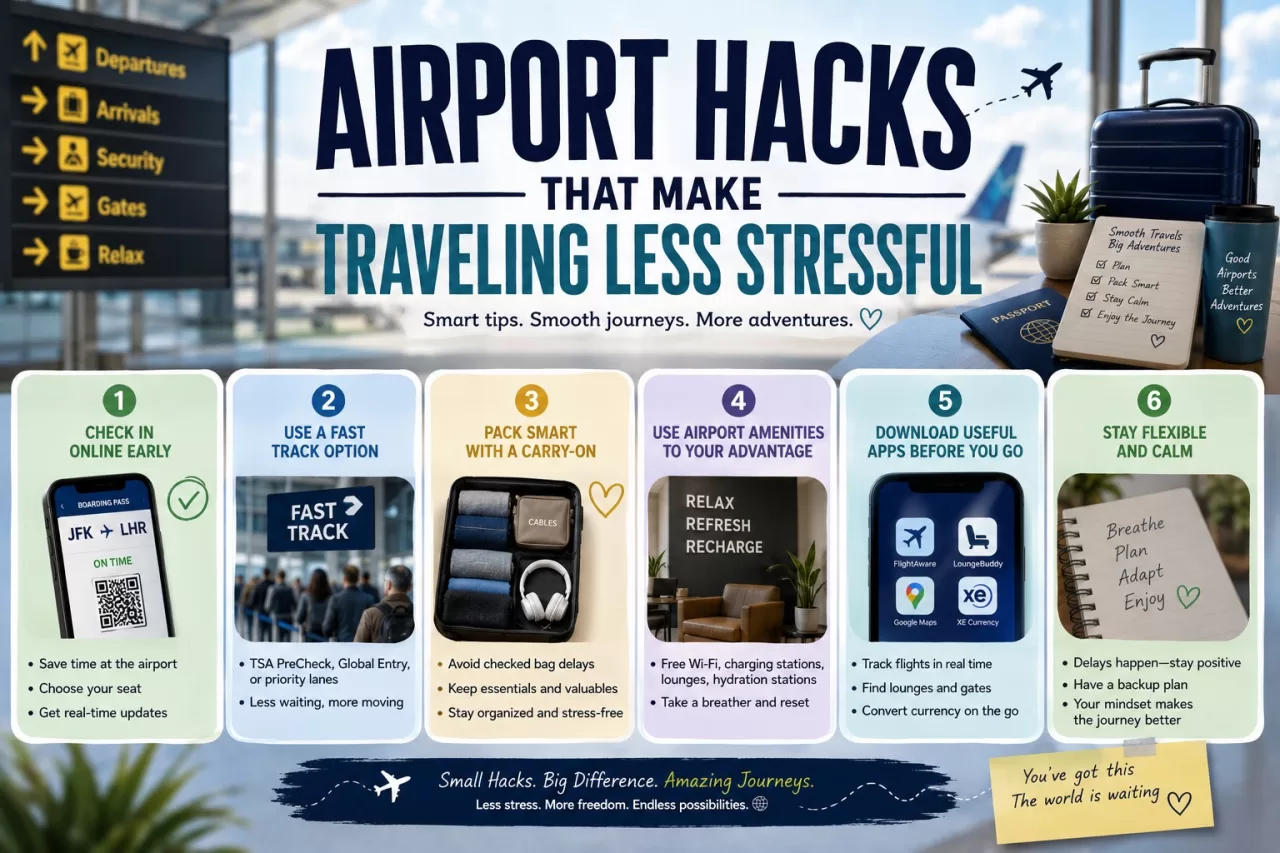
Most airport stress comes from a small number of avoidable situations — long security lines, tight layovers, disorganized carry-ons, and not knowing what to do when something goes wrong. None of these require insider knowledge to fix, just a bit of preparation before arriving at the terminal.
▤ Contents⌃
- 1Check In Online and Get a Digital Boarding Pass Early
- 2Apply for Expedited Security Programs If Flying Often
- 3Pack the Carry-On With Security in Mind
- 4Arrive With the Right Amount of Buffer — Not Too Much, Not Too Little
- 5Use Lounge Access Even Without Flying Business Class
- 6Keep Essential Documents in One Place
- 7Download Everything You'll Need Before Boarding
- 8Know the Layover Minimums Before Booking
- 9Bring a Portable Charger and a Universal Adapter
- 10Have a Plan for Delays and Cancellations Before They Happen
- 11Time Long-Haul Flights to Help With Jet Lag
- 12Use Airport Apps for Real-Time Navigation
- 13Quick Reference Checklist
- 14Frequently Asked Questions
- 15Reducing Airport Stress Comes Down to Preparation
Check In Online and Get a Digital Boarding Pass Early
Checking in as soon as it opens (usually 24-48 hours before departure) does more than save a few minutes at the counter — on full flights, earlier check-in sometimes affects seat assignment and, for some airlines, standby priority if a flight gets overbooked. Downloading the boarding pass to a phone wallet app, rather than relying on the airline app alone, means it's still accessible even without a signal or with a dead battery on airport WiFi.
Apply for Expedited Security Programs If Flying Often
Programs like TSA PreCheck (US), Global Entry (US, includes expedited customs), and similar fast-track security schemes in other countries cut security wait times significantly and remove the need to take off shoes, belts, and jackets or remove laptops from bags. For frequent flyers, the one-time application fee typically pays for itself within a few trips just in time saved.
Pack the Carry-On With Security in Mind
Placing liquids, laptops, and anything else that needs separate screening near the top of the bag, rather than buried underneath clothes, speeds up the security process considerably and reduces the chance of being pulled aside for a manual bag check. A clear, quart-sized bag for liquids kept in an easily accessible pocket avoids the common last-minute scramble at the X-ray belt.
How to build a carry-on that works for both security and the actual trip is covered in more detail in travel packing list: what to bring for every trip.
Arrive With the Right Amount of Buffer — Not Too Much, Not Too Little
Arriving too early wastes time sitting around; arriving too late creates unnecessary stress and risk. A reasonable buffer is usually 2 hours before domestic flights and 3 hours before international ones, adjusted upward for airports known for slow security or during peak holiday travel periods. Checking real-time security wait times, available through some airport apps and TSA's own wait time tool in the US, helps fine-tune this rather than guessing.
Use Lounge Access Even Without Flying Business Class
A number of travel credit cards include airport lounge access as a benefit, and some lounges also sell day passes directly. Lounges offer a quieter place to work, free food and drinks, and generally faster WiFi than the main terminal — useful even for a short layover, and a genuine upgrade during long delays specifically. Which credit cards offer this kind of access as part of a broader rewards structure is covered in best travel credit cards for points and rewards.
Keep Essential Documents in One Place
Passport, boarding pass, ID, and any required visa or entry documents should live in a single, dedicated pocket or pouch, not scattered across a bag. Fumbling for documents at security or the gate is one of the most common sources of avoidable delay and stress. A full list of what to have ready before heading to the airport is in essential travel documents you should never forget.
Download Everything You'll Need Before Boarding
Offline maps for the destination, entertainment for the flight, and any documents needed on arrival (hotel confirmation, a local SIM card QR code, a translation app's offline language pack) are all worth downloading before boarding, since airport and in-flight WiFi can be unreliable or nonexistent depending on the airline and route.
Know the Layover Minimums Before Booking
Booking a connection with too little time between flights is one of the most common sources of missed connections, particularly at large international hub airports where terminal transfers can take 30-45 minutes on their own. As a general guideline, international connections benefit from at least 90 minutes to 2 hours, and more at airports known for long immigration or security lines. Understanding how airlines handle layover timing when booking is covered in best practices for booking flights at the lowest price.
Bring a Portable Charger and a Universal Adapter
Airport outlets are often in short supply or already occupied, and a dead phone at the exact moment a boarding pass or hotel confirmation is needed causes more stress than almost any other single issue. A fully charged portable battery pack, along with a universal adapter for international travel, solves this before it becomes a problem.
Have a Plan for Delays and Cancellations Before They Happen
Knowing airline rebooking policies, having travel insurance that covers delays, and saving the airline's customer service number (not just the app) all matter more in the moment of an actual delay than trying to figure them out under stress at the gate. A full breakdown of what to do when a flight is delayed or canceled is in how to deal with flight delays and cancellations, and what travel insurance actually covers in these situations is explained in travel insurance explained: do you really need it.
Time Long-Haul Flights to Help With Jet Lag
Choosing flight times that align better with the destination's day-night cycle, rather than picking a flight purely on price, can meaningfully reduce jet lag on arrival. Overnight flights that land in the morning, for instance, often work better for adjusting quickly than flights that arrive late at night. Specific strategies for minimizing jet lag on long routes are covered in how to avoid jet lag on long-haul flights.
Use Airport Apps for Real-Time Navigation
Many major airports now have dedicated apps showing live gate information, walking times between terminals, and indoor maps — genuinely useful at large airports where gate changes and long walks between terminals are common. Checking this before landing, rather than relying on overhead signage alone, avoids unnecessary rushing.
Quick Reference Checklist
| Before Leaving Home | At the Airport |
|---|---|
| Check in online, download boarding pass | Have documents in one accessible pocket |
| Charge devices, pack portable charger | Check gate and security wait times on arrival |
| Download offline maps and entertainment | Arrange liquids and electronics for quick screening |
| Confirm layover time is realistic | Know rebooking policy in case of delay |
Frequently Asked Questions
How early should I arrive at the airport?
Generally 2 hours before domestic flights and 3 hours before international ones, with extra time added for airports known for slower security or during high-travel periods like major holidays.
Is TSA PreCheck or Global Entry worth it for occasional travelers?
It depends on flight frequency. Someone flying once or twice a year may not see enough benefit to justify the application process, while anyone flying several times a year typically recoups the time and occasional fee quickly.
What's the biggest avoidable cause of airport stress?
Cutting layover times too close and not knowing airline delay or rebooking policies in advance. Both are easy to prepare for ahead of time and cause disproportionate stress when handled reactively instead.
Reducing Airport Stress Comes Down to Preparation
None of these individually eliminate the possibility of a bad airport day — delays, long lines, and gate changes still happen regardless of preparation. What consistent preparation does is remove the avoidable stress layered on top of situations that are already somewhat out of anyone's control, which is usually where most of the frustration actually comes from in the first place.





Comments 0