
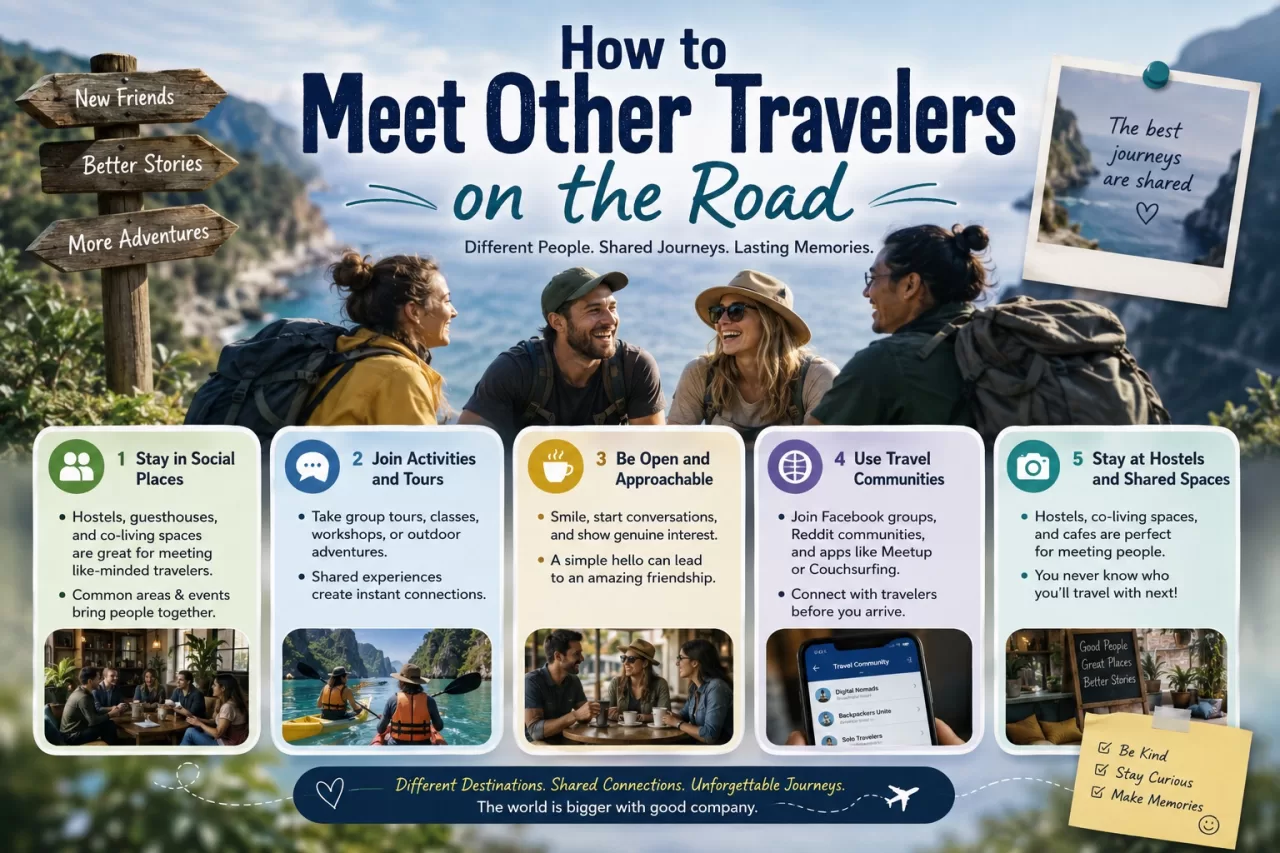
Meeting people while traveling isn't really about luck — certain types of accommodation, activities, and habits consistently put travelers in situations where meeting others happens naturally, while others make it much harder no matter how outgoing someone is. Choosing where to stay and how to structure the first few days in a new place has more influence on this than personality does.
▤ Contents⌃
- 1Choose Accommodation Built Around Socializing
- 2Join Free Walking Tours
- 3Eat at Communal Tables and Group Dinners
- 4Use Apps Built for Travelers
- 5Take Group Day Trips and Tours
- 6Attend Language Exchanges and Local Meetups
- 7Volunteer or Work Exchange
- 8Say Yes to the First Invitation
- 9Balancing Social Time With Safety
- 10What If Meeting People Doesn't Come Naturally?
- 11Longer-Term Connections vs. Short-Term Ones
- 12Quick Reference: Where People Actually Meet
- 13Frequently Asked Questions
- 14The Pattern Behind Meeting People While Traveling
Choose Accommodation Built Around Socializing
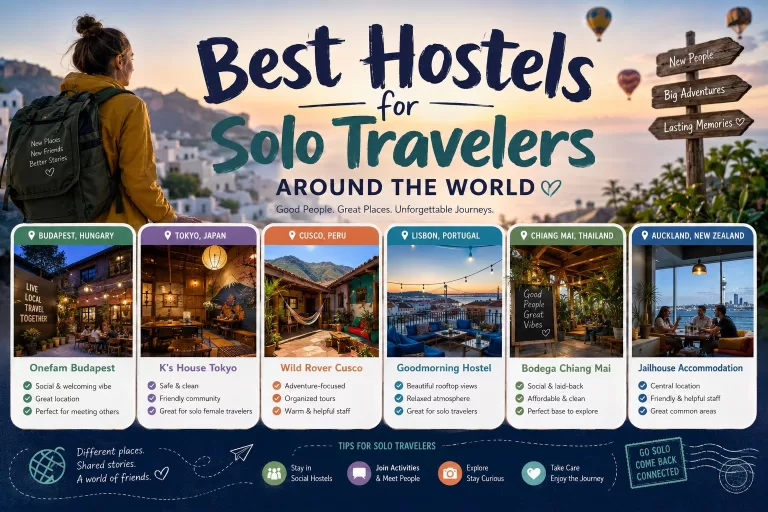
Hostels remain the most reliable way to meet other travelers, but not all hostels are equally social. Common rooms, shared kitchens, organized activities, and bar-on-site setups all increase the odds of conversation happening without needing to force it. Smaller boutique hostels with a strong social reputation often outperform larger chain hostels for this specifically, since the atmosphere tends to be more curated around community rather than just cheap beds. A ranked list of hostels known for this is in best hostels for solo travelers around the world.
Co-living spaces, increasingly common in digital nomad hubs, serve a similar function for longer-term stays — shared common areas and organized events designed specifically to connect residents who are all working and living remotely.
Join Free Walking Tours
Free walking tours (tip-based, widely available in most major cities) are one of the most consistent ways to meet other travelers in the first day or two of arriving somewhere new. The group setting naturally creates conversation during breaks, and the shared experience of exploring a new city together gives an easy starting point for further conversation afterward.
Eat at Communal Tables and Group Dinners
Many hostels organize group dinners or communal cooking nights, and some cities have restaurants specifically built around shared, long tables rather than individual seating. Both formats remove the awkwardness of approaching a stranger, since the setup itself puts people next to each other with an obvious reason to talk.
Use Apps Built for Travelers
A handful of apps exist specifically to connect travelers in the same city — some organized around meetups and events, others more like a map showing which other users are nearby and open to meeting up. These work best combined with in-person activities rather than relying on them alone, since a coordinated meetup (a hike, a bar night, a day trip) tends to lead to more natural connection than an open-ended chat thread. A full list of apps worth having installed, including which ones are actually active in a given region, is in best apps for solo travelers to stay safe, several of which double as meetup tools.
Take Group Day Trips and Tours
Multi-day tours or single-day group excursions — a boat trip, a hiking day, a cooking class — put a small group of people together for several hours with a shared activity to talk about. These tend to work particularly well for travelers who find open-ended socializing harder, since there's a built-in structure and topic rather than needing to initiate a conversation from nothing.
Attend Language Exchanges and Local Meetups
Language exchange events, common in most larger cities, bring together a mix of locals and travelers with a specific, low-pressure format — conversation practice — that makes starting a discussion easy even for people who find small talk difficult. These events are usually free or very cheap and are listed on community event platforms or sometimes directly through hostels and cafes.
Volunteer or Work Exchange
Work exchange platforms, where accommodation is traded for a few hours of daily help (at a hostel, farm, or guesthouse), put travelers into an ongoing shared living and working situation with other volunteers, which tends to build connections faster than short-term encounters do. This works particularly well for longer trips where staying in one place for a week or more is already part of the plan.
Say Yes to the First Invitation
A pattern that comes up repeatedly among experienced travelers: the first invitation in a new place — to a group dinner, a bar, a day trip — tends to open up further connections beyond that one event, since travelers often already know each other from earlier stops or will introduce new people along the way. Turning down the first invitation because of tiredness or shyness often means missing the easiest entry point into a social group that's already forming.
Balancing Social Time With Safety
Meeting people while traveling doesn't mean abandoning basic caution. Meeting in group settings first, sharing plans with someone outside the immediate group, and trusting instinct over social pressure all still apply when socializing with people just met. A fuller breakdown of how to balance this is in solo travel guide: how to travel alone safely.
What If Meeting People Doesn't Come Naturally?
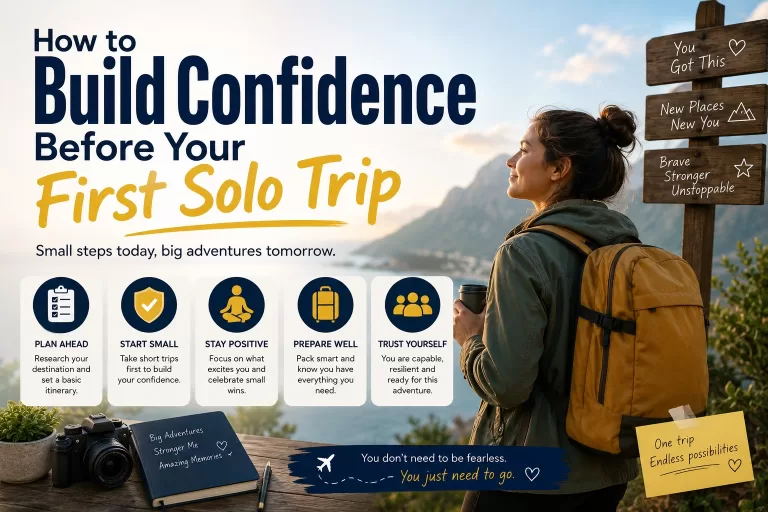
Not everyone finds group hostel common rooms or bar crawls appealing, and that's fine — the methods above aren't the only path to connection. Structured, lower-stimulation settings (a cooking class, a language exchange, a smaller group tour) tend to work better for people who find open, unstructured socializing draining rather than energizing. A dedicated approach for this is covered in solo travel tips for introverts.
Longer-Term Connections vs. Short-Term Ones
Most connections made while traveling are short-term by nature — a few days or a week overlapping in the same place before everyone moves on. This is normal and doesn't make the connection less valuable, but it's worth setting expectations accordingly rather than assuming every good travel friendship needs to last beyond the trip. For travelers specifically staying in one place longer term, such as digital nomads, community-building looks a bit different and is covered separately in digital nomad communities: where to find them.
Quick Reference: Where People Actually Meet
| Setting | Best For |
|---|---|
| Social hostels | Fast, casual connections, especially for first-time solo travelers |
| Free walking tours | Meeting people in the first day or two of arriving somewhere new |
| Group day trips/tours | Structured settings for travelers who find open socializing harder |
| Language exchanges | Meeting locals as well as other travelers, low-pressure format |
| Work exchanges | Deeper, longer-term connections over shared daily routine |
Frequently Asked Questions
Is it harder to meet people while traveling alone in non-English-speaking countries?
Somewhat, though most social hostels, tours, and traveler-focused meetups operate in English by default, since they're built around a mixed international crowd. Language exchanges specifically bridge this gap by design.
Do these methods work for longer trips as well as short ones?
Yes, though longer trips allow for deeper connections through options like work exchanges or repeated meetups in the same community, which a short trip doesn't have time for.
What's the single most effective way to meet people quickly in a new place?
Staying in a social hostel and joining a free walking tour within the first day or two tends to produce the fastest results, since both put a traveler directly into a group setting with an obvious reason to talk to others.
The Pattern Behind Meeting People While Traveling
Almost every reliable method for meeting other travelers comes down to the same underlying structure: a shared activity or setting that gives people an obvious, low-pressure reason to talk to each other. Choosing accommodation, tours, and activities with that structure built in does far more than personality or luck, and it works whether the goal is a quick conversation over breakfast or a friendship that continues well past the trip itself.

Comments 0