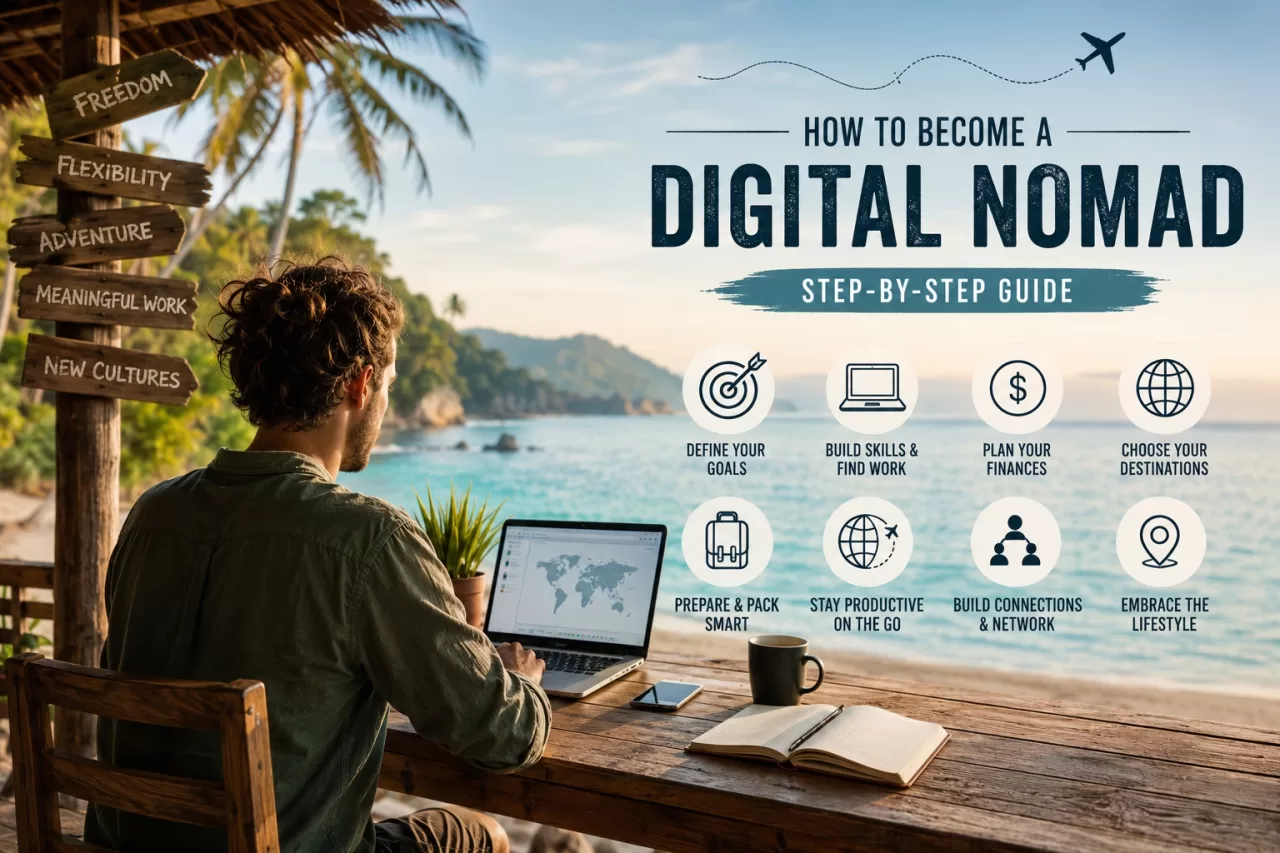
Becoming a digital nomad involves more moving parts than most guides let on — it's not just "get a laptop job and go." Income needs to be reliable before travel starts, not after. Visas and health coverage need sorting out in advance, not improvised on arrival. And the destinations that work well for tourism often aren't the same ones that work well for actually living and working somewhere for months at a time.
▤ Contents⌃
- 1Step 1: Secure Reliable Remote Income First
- 2Step 2: Build a Financial Buffer Before Leaving
- 3Step 3: Understand Visa Options Before Choosing Where to Go
- 4Step 4: Sort Out Health Insurance Before You Need It
- 5Step 5: Get the Right Gear Before You Leave, Not After
- 6Step 6: Choose a First Destination Strategically
- 7Step 7: Find Housing and a Place to Work
- 8Step 8: Build a Routine That Actually Supports Work
- 9Step 9: Understand Tax Obligations Early
- 10Step 10: Find a Community Rather Than Figuring It Out Alone
- 11Transitioning Gradually vs. All at Once
- 12Managing Money So It Lasts
- 13A Realistic Preparation Timeline
- 14Frequently Asked Questions
- 15What This Actually Takes
This guide walks through the process in order, from securing remote income to picking a first destination and setting up the practical systems that make long-term travel sustainable rather than a short-lived experiment.
Step 1: Secure Reliable Remote Income First
This is the step that determines whether everything else works. Attempting to travel first and figure out income later is one of the most common reasons people end up cutting the lifestyle short. There are three main paths into remote income:
| Path | Pros | Cons |
|---|---|---|
| Remote employee (existing job goes remote, or a new remote-first job) | Stable income, benefits in some cases | Fixed hours, time zone constraints, employer travel policies vary |
| Freelancing (writing, design, development, consulting) | Flexible schedule, scalable income | Inconsistent income, especially in the first year |
| Running an online business | Highest ceiling, most flexibility | Slowest to become reliable, highest upfront effort |
Most people transitioning into this lifestyle start with the first option, since it offers income stability while the travel logistics are still being figured out. A detailed breakdown of how to actually build toward remote income, including which skills convert fastest into remote-friendly work, is in how to build a remote career that lets you travel.
For those specifically freelancing or job-hunting remotely, the practical side of finding consistent remote work — where to look, what to avoid, how to price services — is covered in how to find remote work while traveling.
Step 2: Build a Financial Buffer Before Leaving
A savings buffer of three to six months of expenses is the standard recommendation before transitioning to full-time remote travel, and for good reason — income from freelancing or a new remote role can be inconsistent in the first several months, and unexpected costs (a broken laptop, a medical issue, a flight change) come up more often than people budget for.
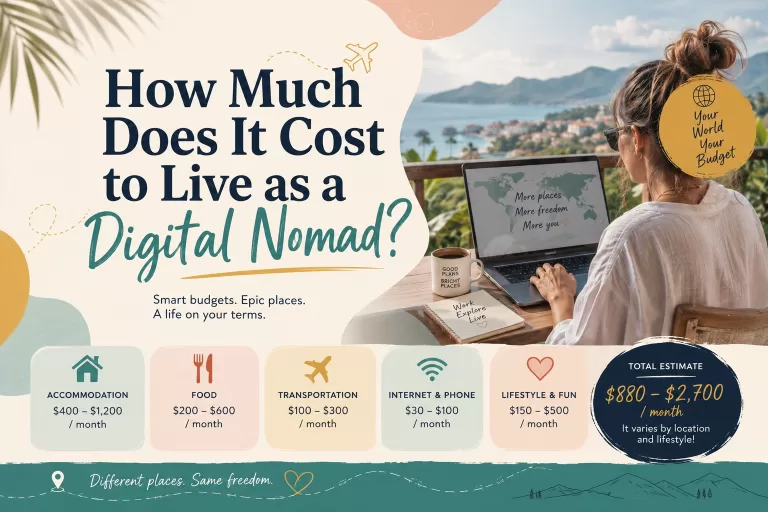
A realistic total cost of living as a digital nomad varies enormously by destination, which is worth mapping out before setting a savings target. A full regional cost breakdown is in how much does it cost to live as a digital nomad.
Step 3: Understand Visa Options Before Choosing Where to Go
Tourist visas are not designed for long-term remote work, and a growing number of countries now offer dedicated digital nomad visas that explicitly permit this — usually for six months to two years, with income or savings requirements attached. Relying on tourist visas and border runs is a common early mistake, and one that's increasingly risky as more countries tighten enforcement around this.
A full comparison of current digital nomad visa programs, requirements, and application processes is in best digital nomad visas around the world.
Step 4: Sort Out Health Insurance Before You Need It
Standard travel insurance is often not sufficient for someone living abroad for extended periods — it's typically designed for short trips and may exclude ongoing care or pre-existing conditions. Dedicated digital nomad health insurance plans exist specifically to cover this gap, and getting one set up before departure avoids being uninsured during the transition.
What separates a genuine digital nomad health plan from standard travel insurance, and what to check for before buying, is covered in digital nomad health insurance: what you need to know. General travel insurance basics that still apply are in travel insurance explained: do you really need it.
Step 5: Get the Right Gear Before You Leave, Not After
A reliable laptop, a good pair of noise-canceling headphones, a universal power adapter, and a portable WiFi hotspot or local SIM solution are the core setup most digital nomads rely on. Buying these while still at home, where returns and warranties are straightforward, is far easier than trying to source reliable tech abroad.
A full breakdown of recommended gear by budget level, along with what's actually worth the investment versus what isn't, is in best laptops and gear for digital nomads.
Step 6: Choose a First Destination Strategically
The first destination matters more than later ones, since it sets the tone for whether the transition feels manageable or overwhelming. A good first destination typically has:
- Reliable, fast internet infrastructure
- An established digital nomad or expat community
- A reasonable cost of living relative to income
- Straightforward visa access (tourist visa or dedicated nomad visa)
- A time zone that's workable for existing clients or employers, if relevant
A ranked list of destinations that consistently perform well across these factors is in best countries for digital nomads in 2026, and for anyone prioritizing cost above all else, best cities for digital nomads on a budget narrows this down further.
Step 7: Find Housing and a Place to Work
Booking a month-long stay rather than a full lease is the standard approach for a first month in a new destination, giving time to assess neighborhoods before committing longer-term. Coworking spaces are worth checking out early too, both for reliable internet and desk setups, and as one of the fastest ways to meet other remote workers in a new city.
A list of coworking spaces known for being genuinely good for long-term remote work (not just tourist-facing cafes with WiFi) is in best coworking spaces for remote workers abroad.
Step 8: Build a Routine That Actually Supports Work
One of the more underestimated challenges of this lifestyle is maintaining consistent work output while constantly adjusting to new environments, time zones, and distractions. A basic routine — consistent work hours, a dedicated workspace even if it's a corner of an apartment, and clear boundaries between travel time and work time — tends to separate people who sustain this lifestyle long-term from those who burn out within a year.
Step 9: Understand Tax Obligations Early
Tax residency and obligations don't disappear just because someone is traveling — they depend on citizenship, how long is spent in each country, and specific tax treaties that vary widely. This is one of the most commonly overlooked parts of the transition, and one where getting it wrong can be expensive to fix later.
A general overview of how this typically works, along with when it's worth consulting a tax professional who specializes in this, is in digital nomad taxes: what you need to know.
Step 10: Find a Community Rather Than Figuring It Out Alone
Isolation is one of the more common reasons people abandon the digital nomad lifestyle, particularly after the initial novelty wears off. Established communities — both online and in specific cities known for a strong nomad presence — make a significant difference here, offering practical advice, social connection, and often direct answers to logistics questions that would otherwise take hours of research.
Where to find these communities, both digital and in-person, is covered in digital nomad communities: where to find them.
Transitioning Gradually vs. All at Once
Not everyone needs to quit a job and leave the country in the same month. A gradual transition — negotiating remote work with a current employer, taking an extended trip first to test the lifestyle, or building freelance income on the side before leaving — reduces financial risk considerably compared to an abrupt full transition.
A detailed comparison of both approaches, including what to have in place before making the leap either way, is in how to transition from a 9-to-5 job to full-time travel.
Managing Money So It Lasts
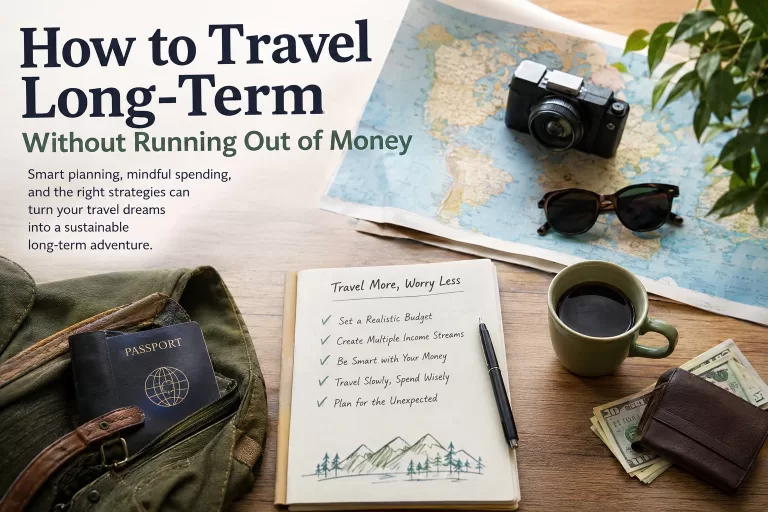
Long-term travel has a different financial rhythm than a two-week vacation, and the spending habits that work for a short trip often don't hold up over months or years. Budgeting with a monthly, sustainable number in mind — rather than a vacation mindset — is what separates people who can do this indefinitely from those who run out of money within a year. Practical strategies for this are covered in how to travel long-term without running out of money.
A Realistic Preparation Timeline
| Timeframe Before Leaving | What to Have in Place |
|---|---|
| 6+ months before | Reliable remote income source, savings buffer started |
| 3-4 months before | Research visa options, research target destinations |
| 2 months before | Buy gear, sort health insurance, understand tax obligations |
| 3-4 weeks before | Book first month of accommodation, join relevant online communities |
| 1 week before | Confirm visa documents, set up banking/card access for travel |
Frequently Asked Questions
Do I need a specific skill to become a digital nomad?
Not necessarily a specific one, but a skill that can be delivered remotely — writing, design, development, marketing, consulting, customer support, and many others qualify. What matters more than the specific skill is whether it can be performed and delivered without being physically present.
How much money do I need saved before starting?
Three to six months of expenses is the common benchmark, though the exact number depends heavily on planned destinations and how stable the income source already is before leaving.
Can I become a digital nomad without quitting my current job?
Often yes, if the role can be done remotely and an employer is open to it. Negotiating remote work with an existing employer is generally lower-risk than leaving a job and building new income from scratch at the same time.
What This Actually Takes
Becoming a digital nomad is less about a single decision and more about a sequence of practical steps done in the right order — income first, then financial buffer, then the logistics of visas, insurance, and destination. Skipping ahead to the travel part before the income and logistics are solid is the most common reason this lifestyle doesn't stick for people who try it. Done in order, it's a manageable transition rather than a leap of faith.



Comments 0