
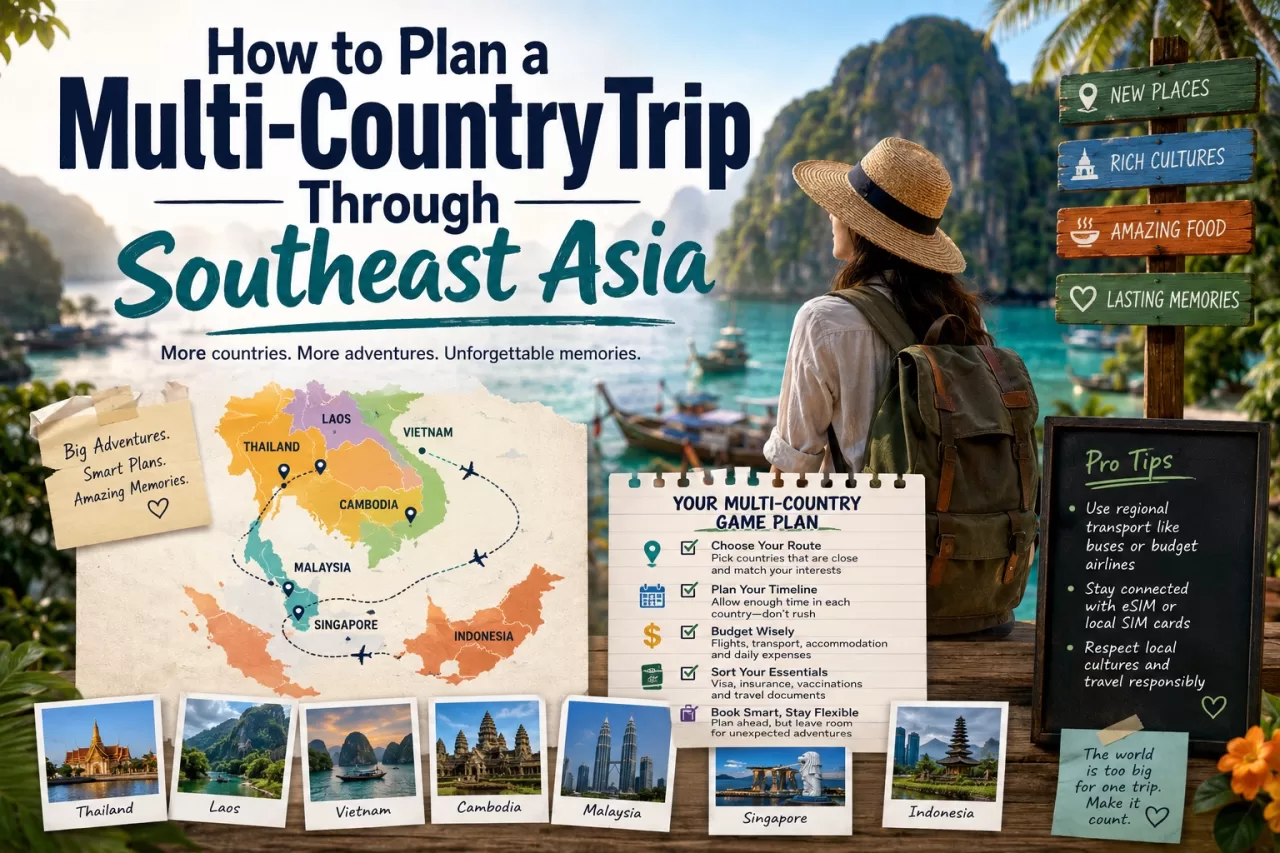
Southeast Asia is one of the easiest regions in the world to combine multiple countries into a single trip, thanks to short flights, land border crossings, and a well-established backpacker route connecting Thailand, Vietnam, Cambodia, Laos, and beyond. The challenge isn't logistics so much as pacing — the region rewards spending real time in fewer places rather than rushing through a long checklist of stops.
▤ Contents⌃
- 1Visa Requirements: What to Check Before Booking
- 2Choosing a Route
- 3Getting Between Countries
- 4When to Go
- 5Budgeting for a Multi-Country Trip
- 6A Sample 3-4 Week Mainland Itinerary
- 7Solo Travel Across the Region
- 8Insurance and Health Considerations
- 9Common Mistakes on Multi-Country Trips
- 10Frequently Asked Questions
- 11Building a Trip That Actually Fits the Region
Visa Requirements: What to Check Before Booking
Visa rules across the region vary by nationality and change periodically, so figures should always be confirmed against official government sources close to departure rather than relied on from an older source. As a general guide for common visitor nationalities (US, UK, EU, Canada, Australia) in 2026:
| Country | Typical Entry for Common Nationalities |
|---|---|
| Thailand | Visa exemption for many nationalities, typically up to 60 days, extendable in-country |
| Vietnam | E-visa (around $25-50 depending on single/multiple entry) for most nationalities, some countries visa-exempt for shorter stays |
| Cambodia | E-visa or visa on arrival, roughly $30-37, straightforward process |
| Laos | E-visa or visa on arrival for most nationalities |
| Malaysia | Visa-free for 30-90 days depending on nationality, requires a Malaysia Digital Arrival Card (MDAC) completed before arrival |
| Indonesia | Visa on arrival, roughly $35, for most common nationalities |
| Singapore | Visa-free for most nationalities, requires a digital arrival card (SGAC) before entry |
A regional proposal for a unified "Southeast Asia Common Visa," similar in concept to Europe's Schengen zone, has been discussed among several ASEAN members, but it isn't yet implemented across the region as of 2026 — each country still needs to be checked and entered individually for now. A broader look at how visa research fits into general trip planning is in how to get travel visas without the hassle.
Choosing a Route
Most multi-country Southeast Asia trips follow one of a few common patterns, largely shaped by geography and flight/overland connections.
The classic mainland loop: Thailand → Laos → Vietnam → Cambodia → back to Thailand, following the Mekong region overland with a mix of buses, trains, and short flights. This route works well because these four countries border each other and have well-established overland crossings.
Thailand and the islands: A narrower trip focused on Thailand itself, plus a jump over to Cambodia or Laos, spending more time in fewer places rather than covering the full mainland loop.
Maritime Southeast Asia: Indonesia, Malaysia, Singapore, and the Philippines are less connected by land and require more flights between stops, but they offer a different mix of experiences — island-hopping, diving, and distinct cultural stops that don't fit neatly into the mainland loop.
Getting Between Countries
Budget airlines dominate short-haul routes across the region, with several offering frequent, low-cost connections between major cities. Comparing base fares against baggage and seat fees matters here just as much as anywhere else, and a full breakdown of how to book these correctly is in best budget airlines and how to book them cheaply.
Overland travel — buses, trains, and shared vans — connects most of mainland Southeast Asia and is often the cheaper and more scenic option for shorter distances, particularly between Thailand, Laos, Cambodia, and Vietnam. Land border crossings can involve some waiting and informal fees at certain crossings, so building in extra time and carrying small denomination cash for these crossings avoids unnecessary stress.
When to Go
Southeast Asia's climate doesn't move on a single calendar — different parts of the region have different dry and wet seasons, and timing a multi-country trip well means checking each destination rather than assuming one season applies everywhere.
| Region | Best Weather Window |
|---|---|
| Thailand, Laos, Cambodia, Vietnam (north) | November-February (cooler, drier) |
| Vietnam (south) | December-April |
| Indonesia, Malaysia | May-September (varies by specific island/region) |
| Philippines | December-May (avoiding typhoon season) |
Overall, roughly November through February tends to work well across most of mainland Southeast Asia at once, making it the most common window for multi-country trips through that part of the region.
Budgeting for a Multi-Country Trip
Southeast Asia remains one of the more affordable regions for extended travel, though costs vary noticeably by country — Vietnam, Laos, and Cambodia tend to be cheaper day to day than Thailand or Malaysia, and Singapore is a clear outlier at a considerably higher cost than the rest of the region. A daily budget of $25-40 covers a comfortable, frugal trip across most of the mainland countries, rising toward $50-70 for a more comfortable pace with some upgraded accommodation and activities. A fuller regional cost breakdown, including country-specific detail, is in how to travel on a budget: a complete beginner's guide.
A Sample 3-4 Week Mainland Itinerary
| Days | Location | Focus |
|---|---|---|
| 1-4 | Bangkok, Thailand | Arrival, city, temples |
| 5-7 | Chiang Mai, Thailand | Northern culture, food, nature |
| 8-10 | Luang Prabang, Laos | Temples, waterfalls, slower pace |
| 11-14 | Hanoi & Ha Long Bay, Vietnam | Northern Vietnam, boat trip |
| 15-18 | Hoi An & Ho Chi Minh City, Vietnam | Central and southern Vietnam |
| 19-21 | Siem Reap, Cambodia | Angkor Wat and surrounding temples |
| 22-25 | Southern Thailand islands | Beach time before departure |
This route groups countries geographically to minimize backtracking, though it can easily be shortened by dropping a country or lengthened by adding more time in any single region, particularly Vietnam, which is large enough to justify two or three weeks on its own.
Solo Travel Across the Region
Southeast Asia remains one of the most popular and well-supported regions globally for solo travel, with an established backpacker infrastructure, social hostels, and well-worn routes that make it easy to meet other travelers along the way. General solo travel safety practices still apply throughout, and are covered in solo travel guide: how to travel alone safely.
Insurance and Health Considerations
A multi-country trip through Southeast Asia typically involves more border crossings, activities, and transport types than a single-destination trip, which makes adequate travel insurance particularly important. Coverage should be checked against every country on the itinerary specifically, not just the primary destination, and what to look for in a policy for this kind of trip is covered in how to choose travel insurance for international trips.
Common Mistakes on Multi-Country Trips
- Trying to cover too many countries too quickly, which tends to reduce overall trip satisfaction compared to spending real time in fewer places.
- Not checking each country's visa requirements individually, assuming rules are the same across the region when they vary significantly by nationality and country.
- Underestimating overland travel times, particularly for mountainous routes in Laos and northern Vietnam, where distances take longer than a map alone suggests.
- Booking too tight a connection at land borders, which can involve unpredictable waiting times compared to flying between countries.
Frequently Asked Questions
How many countries should a first multi-country Southeast Asia trip include?
Three to four is a reasonable target for a three to four week trip. Attempting more than that in the same timeframe usually means less time in each place and more days spent purely in transit.
Is it cheaper to fly or travel overland between countries?
It depends on the specific route. Budget airlines are often cheaper for longer distances (Thailand to Vietnam, for instance), while overland travel tends to be cheaper and more practical for shorter, well-connected distances like Thailand to Laos.
Do all Southeast Asian countries require a separate visa?
Currently, yes — there's no unified regional visa yet, despite ongoing discussion of one. Each country needs to be checked and, if required, applied for individually.
Building a Trip That Actually Fits the Region
The most successful multi-country Southeast Asia trips tend to follow the geography rather than fight it — grouping bordering countries together, allowing realistic time for overland travel, and resisting the temptation to add "just one more stop" to an already full itinerary. A well-paced trip through three or four connected countries generally leaves a stronger impression than a rushed sprint through six.




Comments 0